Every brand has a voice document. Almost none of them work.
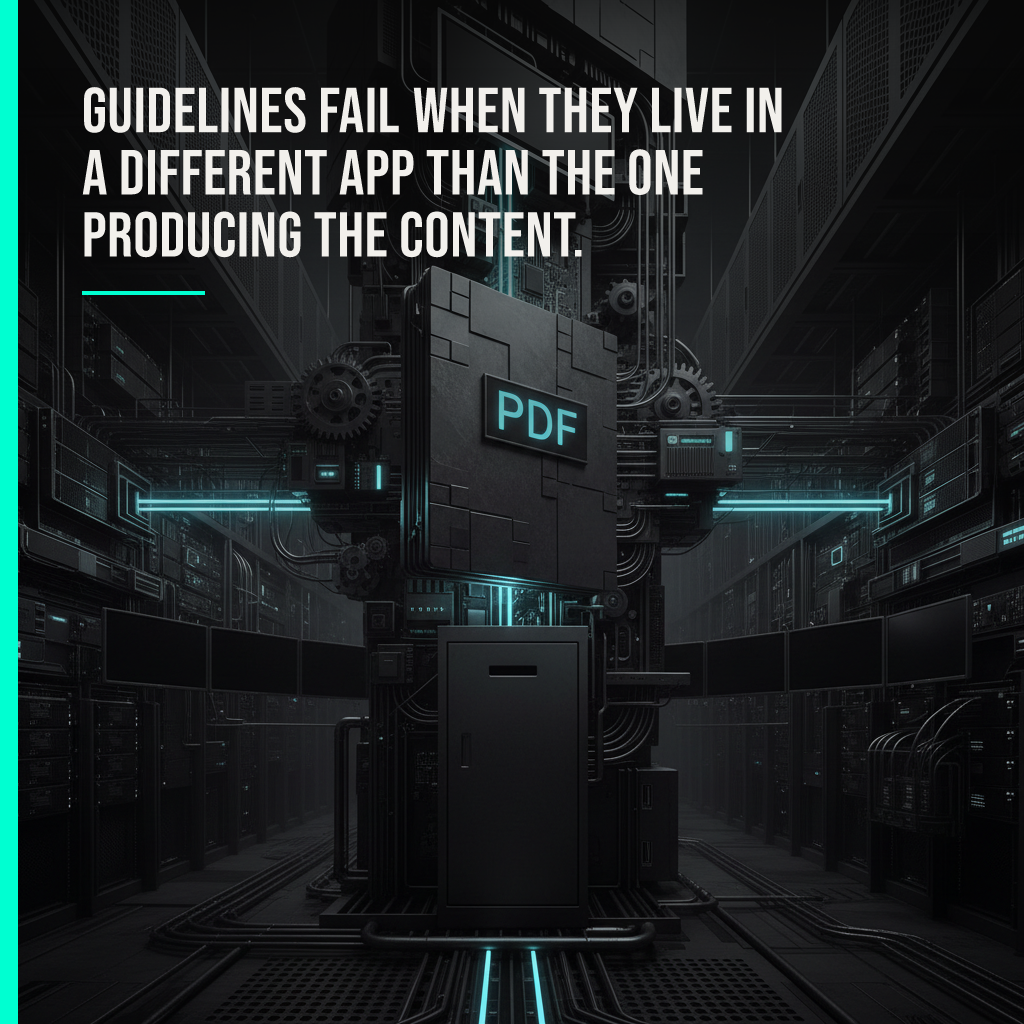
The reason isn't the writing inside. It's the format. A PDF sits in a shared drive while the actual content gets produced somewhere else entirely: inside ChatGPT, inside Claude, inside Cursor, inside whatever tool the freelancer of the week happens to have open. Nobody drags a 40-page brand guide into a prompt window before asking for a caption. The guidelines were never wrong. They were just never *there* when the work happened.

Training was never the problem it claimed to solve
Kill this belief first: inconsistency is not a discipline problem. Referencing the guidelines more often won't stop tone drift. It can't. You can't enforce a rule that lives in a different application than the one producing the content. Asking a human to manually check every AI output against a static document doesn't scale past the second person on the team. It certainly doesn't scale across five tools running five sessions with five different memories of what your brand sounds like.
The market sold you training as the fix. Onboard the new hire, walk them through the deck, hope it sticks. Training assumes the failure point is human memory. It isn't. The real failure point is architecture. The rules and the generation happen in separate systems, so the rules apply only when someone remembers to open the second tab.
MCP moves the rule into the generation layer itself
Model Context Protocol changes where the rule lives. MCP is the technical standard that lets an AI client — Claude, ChatGPT, Cursor, Copilot — pull structured context directly into its generation process, in real time, instead of relying on a human to paste instructions in manually. Brivvy launched on April 8, 2026 as an MCP server built specifically for brand voice, according to Brivvy's own changelog (brivvy.io/changelog). The distinction matters mechanically. Instead of a static document a person has to remember to consult, the glossary and the tone rules sit inside the same protocol layer the AI is already generating from. The tool doesn't check the rules after the fact. It receives them before it writes a single word.
Here's the mechanism, step by step. A brand defines its rules once: tone sliders for Warmth, Confidence, Formality, Playfulness, Technical Depth, plus hard rules on punctuation, formatting, spelling, dates, times, units, preferred terms, and banned phrases. That definition lives in one place. When a connected AI client generates a communication, it queries that same source through MCP and receives the glossary and rule set as live context, not as a reference document but as an active constraint on the output itself. If a term is banned, the model doesn't produce it and get corrected afterward. It never produces it in the first place, because the constraint arrived before generation, not after.
That single architectural choice is what breaks the old cycle: enforcement at generation time instead of after the fact.
What enforcement at generation time actually removes
Post-hoc review carries a cost on every piece of content. Someone reads it, flags the drift, sends it back, someone rewrites it. Multiply that by every tool, every freelancer, every week, and the real cost isn't the rewrite. It's that the correction never accumulates into a system. Next week, the same mistake happens again, in a different tool, because the rule was never connected to the machine doing the writing. Enforcement at generation time removes the correction step because there's nothing left to correct. The rule was already inside the sentence before the sentence existed.
Take a business owner running content across three tools: Claude for long-form, ChatGPT for quick drafts, Cursor for product copy. Under the PDF model, each tool produces a slightly different version of the brand, because each tool has a different human feeding it a different fragment of the guidelines from memory. Under an MCP-connected model, all three tools query the same glossary and the same tone sliders. The consistency doesn't come from three people trying hard to remember the same document. It comes from there being only one document, wired directly into the generation layer of every connected client.

The same logic applies to an agency managing multiple client voices at once. The failure mode there isn't ignorance of the client's tone. It's the sheer number of tools and freelancers touching the account, each carrying their own partial mental model of "how this client sounds." A glossary defined once and enforced at generation time doesn't ask the agency to trust that everyone remembers correctly. It removes the need for that trust, because the terminology and phrasing rules attach to the output mechanism, not to anyone's memory of a meeting six weeks ago.
The rule was already inside the sentence before the sentence existed.
The guidelines were fine. The architecture wasn't
None of this argues that voice guidelines were badly written. Most weren't.
The argument is narrower, and harder to dismiss: a rule that lives outside the tool doing the generating is a rule that gets skipped. Not because people are careless, but because remembering to open a second document before every prompt is not how anyone actually works. Move the rule into the protocol the generation runs on, and the skipping stops being possible.
Unrealville Studio's AI Intelligence layer runs on this same principle. Brand rules get wired directly into the generation architecture, not stored beside it. The Blueprint captures the voice once. Every lab that produces from it — copy, image, video, web — inherits the same constraint at the moment of generation, across every tool in the pipeline.
Not a document teams are asked to consult. A system they can't bypass.
❯ Unrealville Studio